Arthur Hayes Eyes More ZEC: Why the $300–$350 Range Could Be a Strategic Buy Zone
Arthur Hayes and His ZEC Strategy
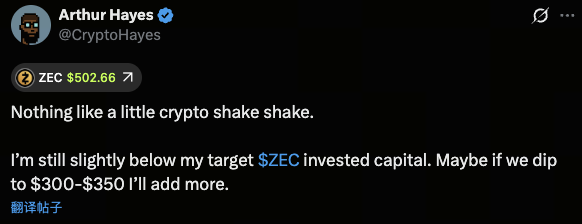
Arthur Hayes is widely regarded as one of the most influential voices in the crypto and macro-finance space. Known for his contrarian yet data-driven investment views, Hayes has frequently discussed the strategic role of alternative digital assets in a diversified portfolio.
Recently, he confirmed that Zcash (ZEC) — a privacy-focused cryptocurrency — is his second-largest crypto holding after Bitcoin (BTC). However, Hayes disclosed that his ZEC allocation target has not yet been met, adding that he might “buy more if the price dips to $300–$350.”
This revelation immediately stirred debate among traders, especially as ZEC has experienced both a powerful rally and volatile corrections throughout 2025.
The Current Market Context for Zcash (ZEC)
Zcash (ZEC) has made a remarkable comeback this year. After languishing near multi-year lows, the token surged significantly in the second half of 2025, briefly becoming one of the top-performing privacy coins.
Market data from several exchanges show that ZEC’s volatility has increased, with traders closely watching its price action around key support levels. Despite this rebound, many analysts warn that the coin remains technically overbought, leaving room for near-term pullbacks before any sustainable leg higher.
For Hayes, however, such pullbacks appear to represent opportunity rather than risk — a perspective consistent with his long-term accumulation style.
Why $300–$350 Is Hayes’ Potential Buy Zone
Hayes’ mention of the $300–$350 price zone was not arbitrary. There are several strategic considerations behind it:
Cost Averaging Strategy: Hayes is likely aiming to lower his average cost basis by buying during dips, improving his long-term profit potential.
Psychological and Technical Support: Technical charts show prior consolidation zones near $320–$340, which could serve as strong re-entry levels during market corrections.
Institutional Liquidity Zones: High-volume nodes and liquidity clusters in this range suggest that larger investors, including family offices, may view it as a logical accumulation band.
Macro Correlation: Given Hayes’ background as a macro trader, his price targets often align with broader market cycles — such as Bitcoin consolidations or regulatory shifts affecting privacy assets.
In essence, the $300–$350 window acts as a tactical patience point, signaling that Hayes prefers disciplined entry rather than chasing momentum.
ZEC Fundamentals: The Case for Privacy Coins
Zcash remains a pioneer in zero-knowledge proof technology, which enables users to conduct transactions that are verifiable yet private. Unlike fully anonymous coins such as Monero (XMR), ZEC allows for selective transparency, meaning users can choose to disclose transaction data for audit or compliance purposes.
This dual nature — privacy plus optional transparency — makes ZEC particularly interesting in a post-regulation world, where privacy is under pressure but still valuable.
Hayes has previously argued that privacy will be a premium commodity in future financial systems, and ZEC’s unique cryptographic design positions it well within that thesis.
Moreover, renewed attention toward Web3 data protection and sovereign transaction rights could eventually re-rate privacy tokens, making ZEC an appealing asymmetric bet for long-term portfolios.
Market Risks and Investor Cautions
Despite its technological appeal, ZEC faces substantial challenges:
Regulatory Scrutiny: Privacy coins have been delisted from several major exchanges in past years due to compliance issues. Any renewed crackdown could restrict liquidity and visibility.
Volatility Risk: ZEC’s price swings are among the sharpest in the top 100 cryptocurrencies. Without proper risk management, such volatility can quickly erase short-term gains.
Ecosystem Limitations: While ZEC has a loyal community, its DeFi and cross-chain integrations remain limited compared to competitors like Monero or newer zero-knowledge projects.
Market Rotation: As investors rotate between Layer-1s, memecoins, and privacy assets, ZEC could experience liquidity shifts that impact short-term performance.
For these reasons, even though Hayes’ confidence lends credibility to the asset, retail investors should maintain realistic expectations and avoid over-allocating based on influencer sentiment alone.
What Retail Traders Can Learn from Hayes
Arthur Hayes’ approach illustrates several key lessons for average investors:
Patience Over Impulse:
Strategic accumulation during dips often outperforms panic buying during rallies.Defined Targets:
Setting a specific re-entry zone, as Hayes did with $300–$350, brings discipline to an otherwise emotional market.Risk-Aware Diversification:
Even Hayes, a seasoned trader, treats ZEC as part of a broader macro portfolio — not a standalone bet.Privacy Narrative Awareness:
Understanding broader narratives (like privacy or decentralization) helps contextualize why an asset might perform over time.
In other words, the insight is not in copying Hayes’ moves, but in understanding his framework — combining conviction with structured risk management.
Conclusion: Between Conviction and Caution
Arthur Hayes’ statement about ZEC has re-energized attention toward privacy coins at a time when digital identity and surveillance concerns are growing worldwide.
His willingness to add ZEC holdings at $300–$350 underscores his confidence in both the technology and the long-term privacy narrative.
Yet, for most investors, this should not translate into blind imitation. Instead, Hayes’ perspective serves as a reminder that discipline, valuation awareness, and macro timing remain at the heart of successful crypto investing.
As the market evolves, those who can balance conviction with caution — just as Hayes aims to do — may be best positioned to navigate the next wave of opportunity in the crypto space.
Disclaimer:
This is not investment advice. This information is provided for informational purposes only and should not be construed as a recommendation to buy, sell, or hold any asset. Cryptocurrency trading involves a risk of loss. Gate US services may be restricted in certain jurisdictions. For more information, please see our legal disclosures: https://us.gate.com/legal/disclosures
Share
Content


Related Articles

Bitcoin Halving Chart: Key Dates, Trends, and Future Predictions

Bitcoin Halving Chart:Understanding the Changes in Bitcoin Supply and Price Trends

US December Rate Cut Forecast: Will the Federal Reserve Finally Pivot?

Federal Reserve Ends Quantitative Tightening — How the End of QT Could Reshape Global Markets in 2025

Midnight Network Ignites Cardano’s Next Chapter with NIGHT Token Mining and Privacy Innovation