Bitcoin Holds Near $87,000 After Rebounding From Key $82,000 Support — Is a Break Above $90,000 Coming?
Bitcoin is once again at the center of market attention after a sharp rebound from the $82,000 support level. Following several days of turbulence and profit-taking, BTC managed to recover nearly $5,000 in a short span, climbing back to the $87,000 region where it is currently consolidating. The move has sparked optimism among traders who believe the market may be preparing for its next major leg higher — possibly toward the psychological $90,000 mark.
This price behavior reflects a broader trend of volatility in the crypto market, driven by shifting liquidity, macroeconomic uncertainty, and leveraged trading activity. Yet despite these fluctuations, Bitcoin’s ability to hold above a key support level highlights the underlying strength of its current market structure.
Bitcoin’s Latest Price Action: From $82,000 Low to $87,000 Recovery
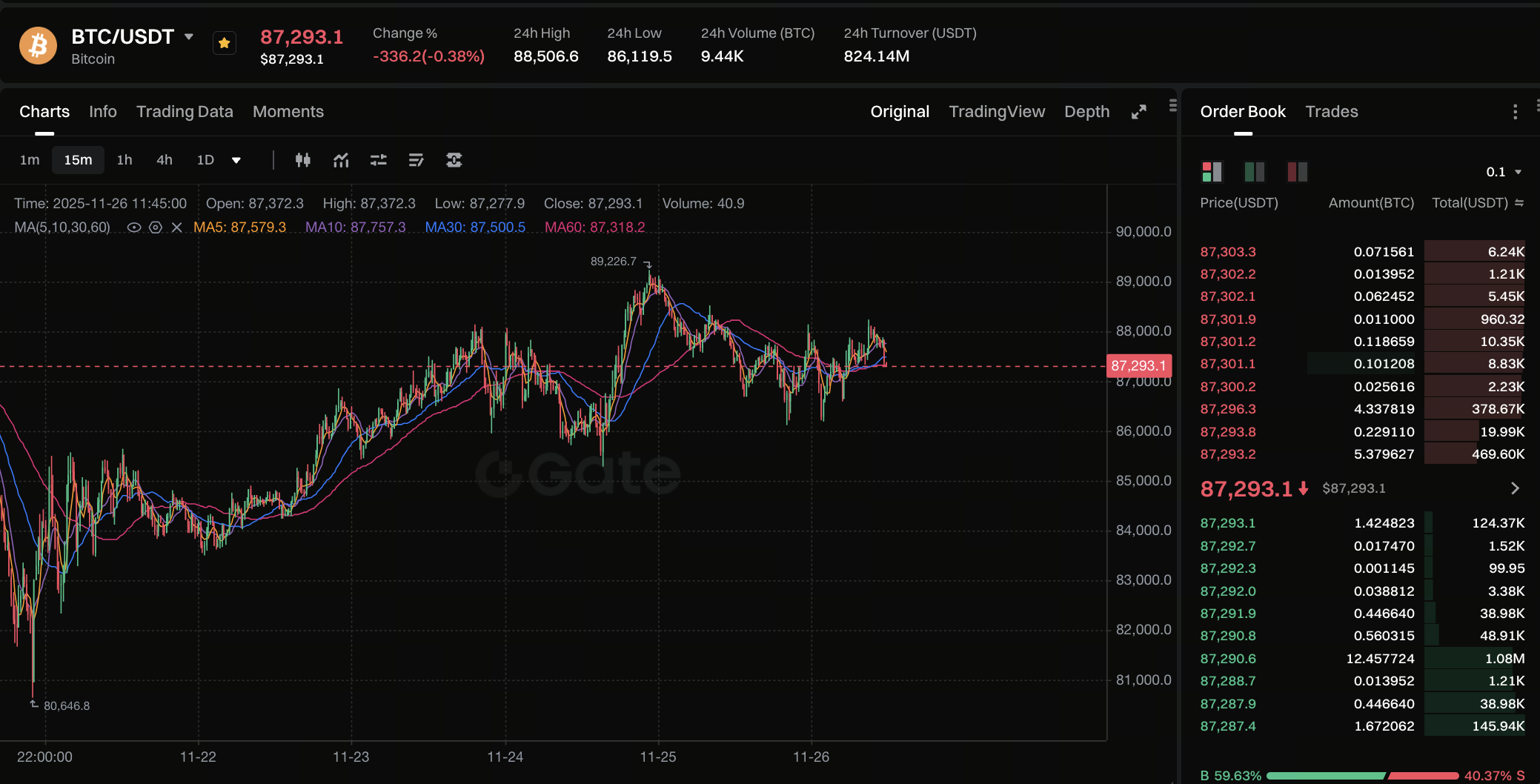
The latest swing started when BTC dipped toward $82,000, a level traders had been watching closely. The drop triggered liquidations of long positions, but instead of cascading lower, the market found strong buying interest. Large buyers, long-term holders, and algorithmic trading systems stepped in, pushing prices swiftly back toward the mid-$80,000s.
Shortly after the rebound, BTC stabilized between $86,500 and $87,500, forming a short-term consolidation range. This behavior is typical during a trend continuation setup, where the market pauses before deciding its next major direction.
Notably, on several exchanges, intraday highs reached around $88,000, reinforcing the idea that buyers are regaining control. Even though volatility remains high, the rapid recovery from the dip has shifted market sentiment from fear back toward cautious optimism.
Technical Factors Supporting the Rebound
Several technical signals contributed to Bitcoin’s ability to bounce from $82,000:
1.Strong Historical Support Zone
The $82,000–$83,000 zone has acted as a major support area multiple times. Buyers have consistently defended this region, signalling that institutional accumulation may be occurring near these levels.
2.Oversold Indicators Triggered Buy Signals
During the drop, short-term RSI and MACD indicators reached oversold territory on 4-hour and daily charts. Historically, such conditions often precede a relief rally or trend continuation, which is exactly what happened.
3.Short Squeeze Dynamics
Funding rates briefly turned negative across major derivatives exchanges, showing that short positions were increasing aggressively. As soon as price reversed, many of these shorts were forced to cover, adding fuel to the upward momentum.
4.Maintaining Higher Lows in the Macro Trend
Despite the correction, Bitcoin continues to maintain a series of higher lows — one of the clearest signals of a healthy bullish trend.
Market Sentiment: Are Bulls Regaining Control?
The rebound has shifted sentiment notably:
Fear of deeper correction has eased.
When Bitcoin failed to break below $82,000, many traders interpreted it as a sign that the market was not ready for a prolonged downturn.Spot accumulation is increasing.
Wallet data shows renewed inflows to long-term holders, an important indicator of market confidence.Leverage is still high, but trending down.
Lower leverage reduces the risk of violent liquidation cascades and makes upward moves more sustainable.
Although sentiment has improved, it is not excessively bullish — a healthy sign that prevents FOMO-driven blow-off tops.
Key Price Levels to Watch: Support at $82K, Resistance at $90K
Bitcoin’s current consolidation suggests that traders should pay close attention to several critical levels:
Support Levels
$82,000: The main structural support; losing this level could trigger a drop to $78,000.
$85,000: Short-term support formed after the latest rebound.
Resistance Levels
$87,500–$88,000: Current consolidation ceiling; a break above would open the way to the next region.
$90,000: Major psychological and technical resistance; a breakout could attract significant spot and derivatives buying.
If Bitcoin holds above $87,000 for several daily closes, the probability of testing $90,000 increases substantially.
Outlook: Short-Term Risks and Long-Term Opportunities
The broader outlook remains cautiously optimistic, supported by fundamentals, investor sentiment, and technical structure.
Short-Term Risks
Bitcoin remains in a high-volatility environment, meaning sharp pullbacks are possible.
Macroeconomic data (such as interest rate decisions) may disrupt market momentum.
Excessive leverage in the futures market could still trigger sudden price swings.
Long-Term Opportunities
Bitcoin’s supply continues to tighten post-halving, reinforcing its long-term scarcity narrative.
Institutional interest remains strong as more funds explore BTC exposure.
If global liquidity conditions improve, risk assets — including Bitcoin — may benefit significantly.
Overall, Bitcoin appears to be stabilizing after a healthy correction, and the move back toward $87,000 suggests buyers are preparing for the next attempt at higher levels. A break above $90,000 could mark the start of a new bullish phase, while holding above $82,000 will remain key for sustaining current momentum.
Disclaimer:
This is not investment advice. This information is provided for informational purposes only and should not be construed as a recommendation to buy, sell, or hold any asset. Cryptocurrency trading involves a risk of loss. Gate US services may be restricted in certain jurisdictions. For more information, please see our legal disclosures: https://us.gate.com/legal/disclosures
Share
Content


Related Articles

Bitcoin Halving Chart: Key Dates, Trends, and Future Predictions

Bitcoin Halving Chart:Understanding the Changes in Bitcoin Supply and Price Trends

US December Rate Cut Forecast: Will the Federal Reserve Finally Pivot?

Federal Reserve Ends Quantitative Tightening — How the End of QT Could Reshape Global Markets in 2025

Midnight Network Ignites Cardano’s Next Chapter with NIGHT Token Mining and Privacy Innovation