Blast Mainnet Collapse: From Layer-2 Superstar to 97% TVL Crash — What Really Happened?
What Is Blast Mainnet and Why It Rose So Fast
Blast Mainnet entered the Layer-2 arena with a radically different narrative. While most L2 networks focused on scalability, throughput, or modular architecture, Blast positioned itself as a native yield Layer-2. Users could earn yield directly on ETH and stablecoins simply by holding assets on the chain — no DeFi complexity required.
This model immediately differentiated Blast from competitors like Arbitrum, Optimism, and Base. More importantly, Blast wrapped this yield design with an aggressive points and airdrop incentive system, triggering massive early capital inflows.
Before the mainnet even launched, billions of dollars were bridged in by users seeking exposure to future token rewards. Social media momentum exploded. Airdrop hunters, funds, influencers, and developers rushed in. At its peak, Blast became one of the fastest-growing Layer-2 networks in crypto history.
The Peak of Blast: TVL Explosion and Market Hype
At its height, Blast’s Total Value Locked reached multi-billion-dollar levels. This surge created the illusion of instant success:
Liquidity surged faster than any previous L2
User growth accelerated rapidly
Ecosystem projects multiplied overnight
Market sentiment turned overwhelmingly bullish
For a brief period, Blast was viewed as a potential “next-generation L2 leader.” However, beneath the surface, a dangerous structural imbalance was forming.
Most of the capital entering Blast was not long-term application liquidity — it was yield-driven speculative capital. The majority of users were not there to use products. They were there to farm points, earn Gold, and position for airdrops.
This distinction became fatal once incentives began to fade.
BLAST Token Price Pressure and Unlock Impact
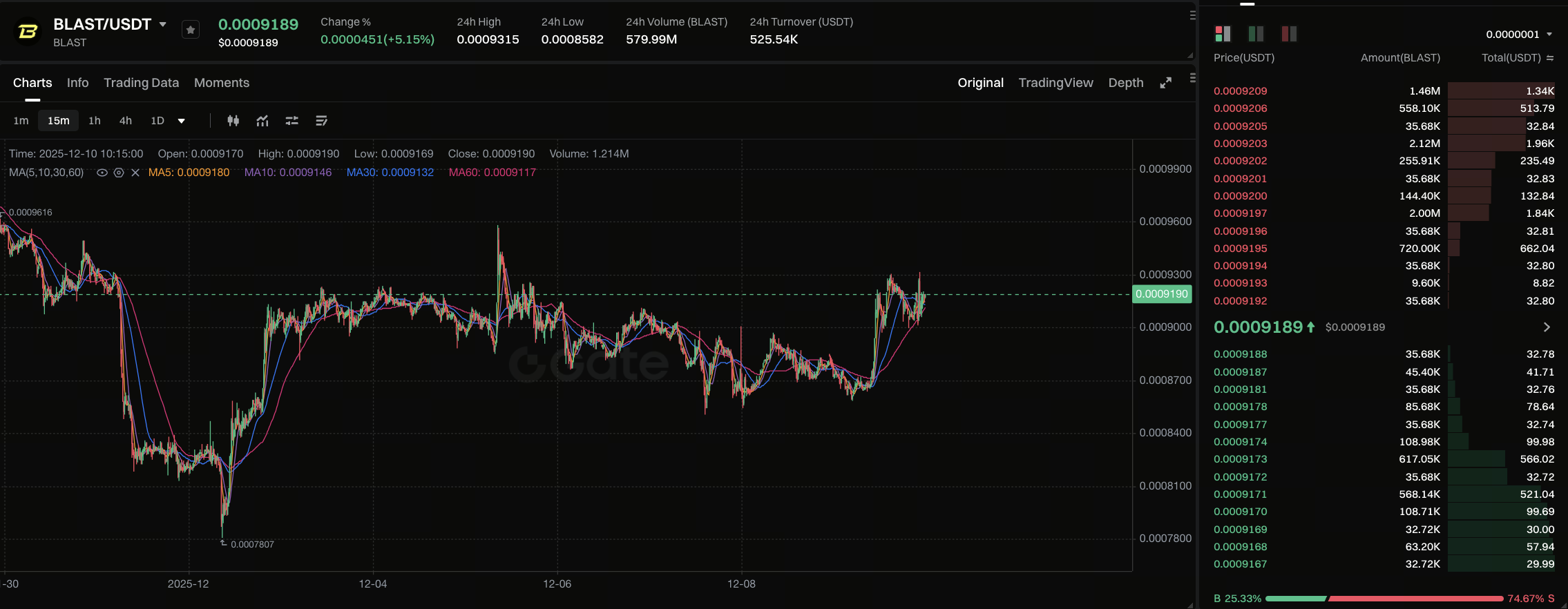
When the BLAST token entered circulation, early enthusiasm supported initial price levels. But as scheduled token unlocks accelerated, the market quickly shifted into a supply-dominant phase.
Several structural problems emerged:
Rapid increase in circulating supply
Weak organic buying demand
High early participant profit-taking
Limited long-term holding conviction
Each unlock cycle introduced new sell pressure into an already fragile market. While short-term relief rallies occurred, the broader trend remained downward.
Without strong real-world demand from DApps or consistent user growth, the BLAST token became highly sensitive to unlock events and sentiment swings.
Why Users and Liquidity Are Leaving
By 2025, Blast’s TVL had collapsed by more than 97% from its peak. This was not a gradual decline — it was a systematic exit.
There are three main reasons behind the liquidity exodus:
1. Incentive Decay
As reward rates declined and airdrop expectations were fulfilled, users had little reason to keep assets locked. Yield alone was no longer competitive relative to risk.
2. Weak Product Stickiness
Most DApps were built around farming mechanics rather than real user demand. When rewards dropped, these products instantly lost relevance.
3. Market-Wide Risk Reduction
As overall crypto market sentiment cooled, speculative capital naturally rotated out of high-risk ecosystems like Blast.
In essence, Blast’s capital base was fundamentally unstable from the beginning.
Ecosystem Crisis: DApps, Developers, and Infrastructure
The collapse of liquidity triggered a chain reaction across the ecosystem.
DApps suffered from shrinking users and liquidity, making it difficult to sustain revenue or operations. Many teams either paused development or exited entirely.
Developers lost confidence as incentive budgets dried up and infrastructure support weakened. Without stable liquidity and users, long-term building became economically unattractive.
Infrastructure instability further accelerated the decline. RPC issues, service migrations, and ecosystem maintenance challenges created friction for both developers and users.
The result was a classic negative feedback loop:
Lower liquidity → fewer users → weaker DApps → lower confidence → even lower liquidity.
Can Blast Mainnet Recover in 2025 and Beyond?
Despite the severity of the collapse, Blast is not technically “dead.” The network still functions. Assets still move. Some applications remain active. However, a true recovery would require structural transformation, not cosmetic updates.
For Blast to regain relevance, three major shifts must occur:
1. Transition from Incentive-Driven Growth to Product-Driven Growth
Real users must arrive not for rewards, but for genuine utility.
2. Development of Long-Term Revenue-Generating DApps
Sustainable DeFi protocols, gaming ecosystems, or consumer applications are required for organic demand.
3. Restoration of Developer Trust and Infrastructure Reliability
Without stable tooling and long-term support, builders will not return.
Without these reforms, any short-term price rebound would likely remain speculative rather than structural.
Key Lessons for L2 Investors
Blast Mainnet provides one of the most important cautionary case studies in modern Layer-2 history:
TVL is not real adoption
Airdrops do not equal sustainable ecosystems
Yield attracts capital fast — but it leaves even faster
User quality matters more than user quantity
For investors, Blast reinforces a core truth: Long-term value comes from usage, not hype. Chains built primarily on incentives face extreme boom-and-bust cycles once rewards fade.
Share


Related Articles

Bitcoin Halving Chart: Key Dates, Trends, and Future Predictions

Bitcoin Halving Chart:Understanding the Changes in Bitcoin Supply and Price Trends

US December Rate Cut Forecast: Will the Federal Reserve Finally Pivot?

Federal Reserve Ends Quantitative Tightening — How the End of QT Could Reshape Global Markets in 2025

Midnight Network Ignites Cardano’s Next Chapter with NIGHT Token Mining and Privacy Innovation