Crypto Whale 0x7b7 Loses $6.44 Million Shorting Bitcoin on Hyperliquid — The $7M Gamble Gone Wrong
Background: The $7M Whale Bet
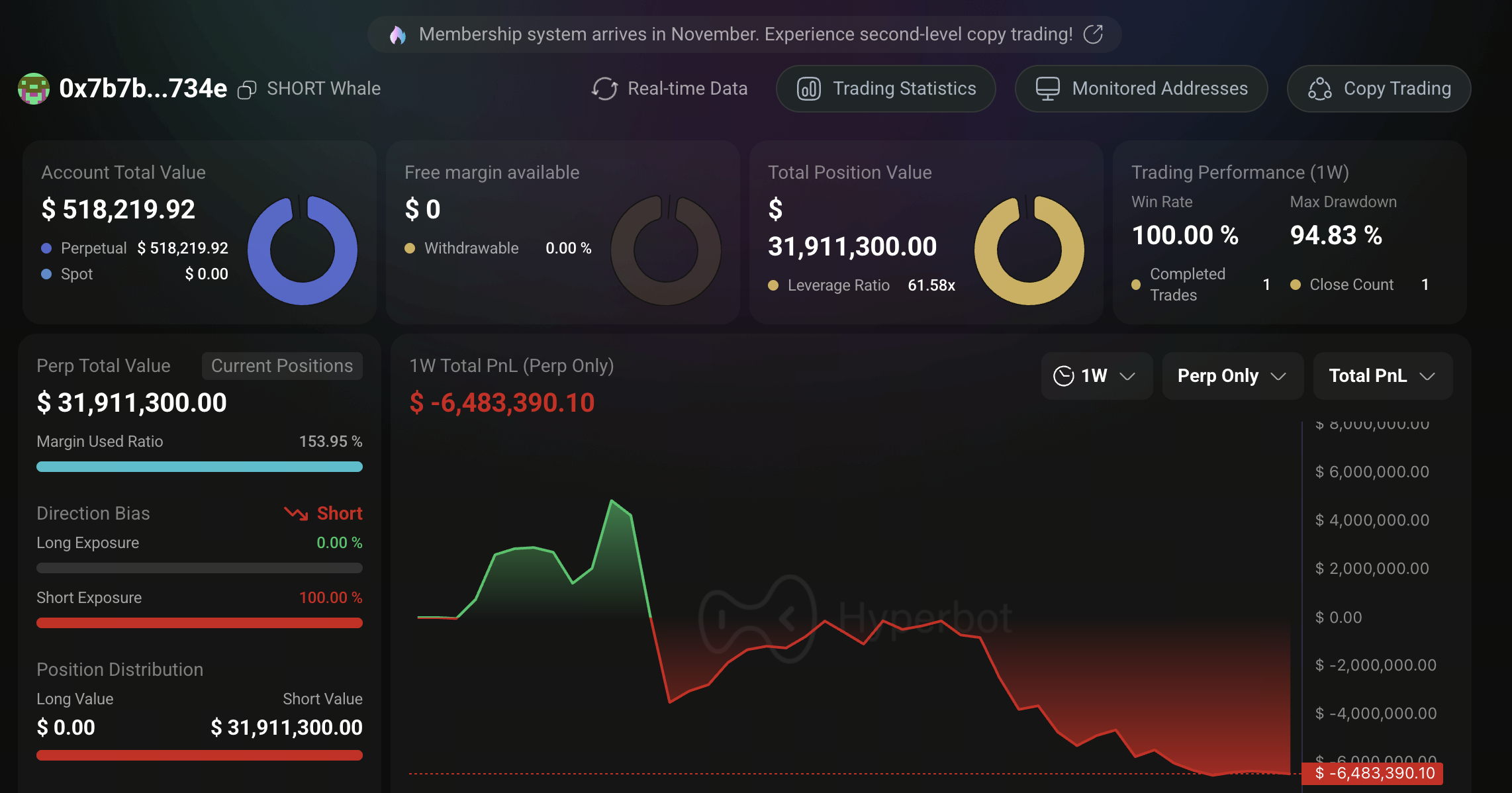
Blockchain trackers spotted a massive on-chain movement earlier this week — wallet 0x7b7b908c076B9784487180dE92E7161c2982734E transferred around $7 million in USDC to the decentralized derivatives platform Hyperliquid.
Soon after the deposit, the whale opened large short positions on Bitcoin and XRP, reportedly using 20x leverage. Market commentators viewed it as a “smart money” signal, suggesting big players expected a market correction.
But three days later, that narrative completely flipped.
The Setup: High-Leverage Short on Bitcoin
At first, the move seemed brilliant. BTC briefly dipped toward $101,000, and the whale’s short positions turned a profit. Social media channels buzzed with claims that the trader had made more than $3 million in unrealized gains.
However, things changed rapidly. The same leverage that amplified early profits soon became a weapon against the whale.
Leverage, especially 20x, means even a 5% move against the position can trigger a liquidation. With BTC rebounding from $101,000 to $105,800, the whale’s margin shrank rapidly. Each stop-loss hit meant more losses, more fees, and less collateral to defend open trades.
After several forced liquidations and manual stop-outs, the once-$7M account was left with just $560,000 — a staggering 92% loss.
The Turning Point: BTC Rebounds Strongly
So what caused this reversal?
Several macro and technical factors aligned almost perfectly against short sellers:
ETF inflows stabilized, signaling renewed institutional demand for Bitcoin.
U.S. risk assets rallied, boosting risk-on sentiment.
The U.S. dollar index weakened, indirectly supporting crypto prices.
As BTC regained key resistance levels, short positions — especially leveraged ones — faced a brutal squeeze. Liquidations on-chain created a cascade effect, adding buy pressure that pushed BTC even higher.
What started as a confident short turned into a textbook short squeeze.
What the Data Shows
Blockchain data confirms the story:
The whale’s initial $7M USDC deposit went into Hyperliquid wallets tied to perpetual futures.
Multiple margin top-ups occurred as BTC rose past $103,000, suggesting attempts to defend the short.
By November 10, only ~$560,000 USDC remained in the wallet, with the rest liquidated or lost through stop-losses.
This kind of transparency — where anyone can watch a whale lose millions in real time — is unique to on-chain trading. Unlike traditional exchanges, decentralized platforms make these losses visible to everyone.
Three Key Lessons for New Traders
Leverage is a Double-Edged Sword
Leverage amplifies profits and losses. At 20x, a 5% move wipes you out. Even experienced traders get caught off-guard by volatility.Whales Can Be Wrong Too
Many new traders assume “smart money” is always right. But whale 0x7b7’s $6.44M loss proves that big wallets can make bad calls — often worse because of their position size.Transparency Doesn’t Mean Safety
On-chain trading gives transparency, not immunity. Just because you can track everything on the blockchain doesn’t mean your trade is safer.Stop-Loss Discipline Matters
The whale’s repeated stop-loss hits show what happens when traders try to “fight” the market. Sometimes the best move is to accept a small loss early.Market Psychology Rules All
When BTC started rebounding, short sellers panicked. Fear, greed, and FOMO can destroy even million-dollar strategies.
Conclusion: Leverage Magnifies Everything
The fall of whale 0x7b7 is more than a viral story — it’s a powerful reminder.In crypto markets, leverage magnifies both your intelligence and your mistakes.Losing $6.44M in 72 hours isn’t just about poor timing; it’s about the illusion of control in a market driven by volatility and emotion.For beginners, this episode is a real-world lesson:“You don’t need to predict the market. You just need to survive it.”
Whether you trade on Hyperliquid, Binance, or any exchange, remember:Managing risk and keeping emotion in check is far more important than chasing the next big win.
Disclaimer:
This is not investment advice. This information is provided for informational purposes only and should not be construed as a recommendation to buy, sell, or hold any asset. Cryptocurrency trading involves a risk of loss. Gate US services may be restricted in certain jurisdictions. For more information, please see our legal disclosures: https://us.gate.com/legal/disclosures
Share
Content


Related Articles

Bitcoin Halving Chart: Key Dates, Trends, and Future Predictions

Bitcoin Halving Chart:Understanding the Changes in Bitcoin Supply and Price Trends

US December Rate Cut Forecast: Will the Federal Reserve Finally Pivot?

Federal Reserve Ends Quantitative Tightening — How the End of QT Could Reshape Global Markets in 2025

Midnight Network Ignites Cardano’s Next Chapter with NIGHT Token Mining and Privacy Innovation