Ethereum Activates Fusaka Upgrade: A New Chapter for Scalability
Ethereum’s Fusaka Upgrade Goes Live
According to the official announcement from the Ethereum team, the Fusaka upgrade was successfully activated at epoch 411392, corresponding to 05:49 AM (Beijing Time) on December 5. With the core changes now implemented, the community is closely monitoring the network’s first 24 hours to ensure smooth performance and overall stability.
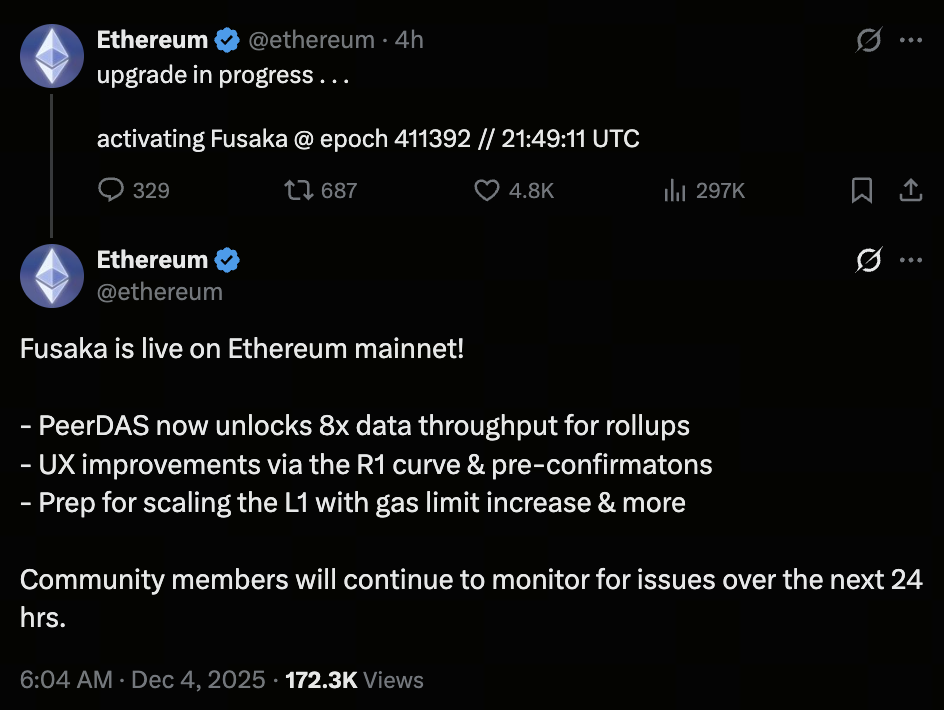
(Image source: ethereum)
PeerDAS: A Transformative Step for Data Availability
The highlight of Fusaka is the introduction of Peer Data Availability Sampling (PeerDAS)—a system designed to make Ethereum’s data availability layer more efficient and scalable.
Key improvements brought by PeerDAS include:
- Substantial expansion of rollup data capacity, estimated at around an 8× increase.
- Greater room for Layer 2 scaling, creating conditions that may further reduce transaction costs.
- Foundational groundwork for potential adjustments to Ethereum’s L1 gas limits in the future.
The integration of PeerDAS is widely seen as a milestone in Ethereum’s journey toward advanced and sustainable scaling.
User Experience Enhancements: R1 Curve + Pre-Confirmations
Beyond scalability, Fusaka also introduces upgrades aimed at refining interaction flow for both mainnet and Layer 2 activities. Two key features included in this release are:
- The R1 curve, which contributes to more efficient processing logic.
- A pre-confirmation mechanism, designed to speed up user feedback during transactions.
Together, these enhancements streamline interactions across the ecosystem, offering smoother and faster user operations.
What Comes Next for Ethereum?
With Fusaka now deployed, Ethereum takes a meaningful step forward in improving cost efficiency, scaling performance, and overall usability. How the market responds—especially regarding ETH price movements—remains to be seen, as real-world traffic and user sentiment begin to shape the post-upgrade environment.
Conclusion
The launch of the Fusaka upgrade signals the beginning of a new era in Ethereum’s scaling roadmap. By incorporating PeerDAS, the R1 curve, and pre-confirmation capabilities, the network strengthens both its performance and user experience. While the broader ecosystem’s reaction will develop in the coming days, one thing is clear: Fusaka brings a significant boost to Ethereum’s long-term evolution and technical momentum.
Share
Content


Related Articles

Bitcoin Halving Chart: Key Dates, Trends, and Future Predictions

Bitcoin Halving Chart:Understanding the Changes in Bitcoin Supply and Price Trends

US December Rate Cut Forecast: Will the Federal Reserve Finally Pivot?

Federal Reserve Ends Quantitative Tightening — How the End of QT Could Reshape Global Markets in 2025

Midnight Network Ignites Cardano’s Next Chapter with NIGHT Token Mining and Privacy Innovation