Lighter: The $68M Crypto Comeback That’s Redefining the Trust Layer of Finance
A Contrarian Move: From AI Back to Crypto
In an era where founders are pivoting toward artificial intelligence, Vladimir Novakovski made the opposite move — leaving AI to return to the foundations of crypto.
Within two years, his company Lighter attracted backing from some of the most influential investors in both tech and finance, including Peter Thiel’s Founders Fund, Haun Ventures, and Robinhood.
This $68 million funding round pushed Lighter’s valuation to $1.5 billion, marking it as one of the fastest-growing projects in the Web3 infrastructure space.
What Exactly Is Lighter?
Lighter operates as both a decentralized exchange (DEX) and an independent blockchain network. Currently, it offers perpetual futures trading and plans to expand into spot trading for major tokens like Bitcoin.
What sets it apart is its dual-layer architecture—combining transparency, verifiability, and fairness at the financial base layer. As Novakovski explains, Lighter’s mission is clear:
“Every financial transaction should be correctly recorded and publicly verifiable.”
This philosophy positions Lighter not merely as a trading platform but as a foundation for trust-based finance.
Who’s Backing Lighter: From Silicon Valley to Crypto Giants
The latest funding round was co-led by Founders Fund and Ribbit Capital, joined by Haun Ventures and Robinhood. Robinhood’s participation is especially notable—its venture involvement is rare, signaling strong confidence in decentralized finance’s future.
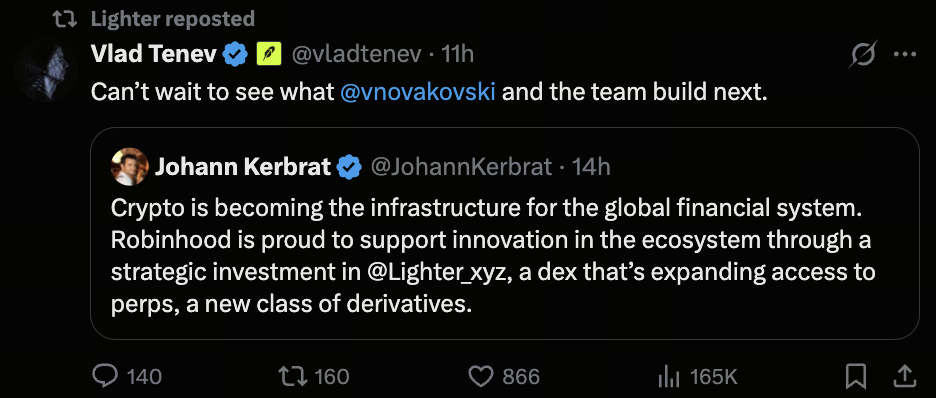
(Image source: Lighter_xyz)
Previously, in 2024, Lighter raised $21 million led by Haun Ventures and Craft Ventures, with participation from Dragonfly and Robot Ventures. With this latest round, Lighter’s total funding now exceeds $89 million, a remarkable figure for a still-emerging DeFi infrastructure project.
Technical Edge: Building on Ethereum Layer 2
Unlike Hyperliquid, which runs on its own Layer 1 chain, Lighter is built directly on Ethereum Layer 2, combining high-speed performance with Ethereum-grade security.
Data from L2BEAT places Lighter among the top Layer 2 projects by total value locked (TVL). This design choice not only enhances user experience but also gives developers and traders a scalable, interoperable environment within the Ethereum ecosystem.
The Founder: From AI Prodigy to Fintech Engineer
Vladimir Novakovski’s background reads like a Silicon Valley legend. Originally from Russia, he represented the U.S. in international informatics and physics Olympiads, entered Harvard at 16, and was hired by Ken Griffin at Citadel as an engineer-trader by 18.
After 15 years in quantitative finance, he co-founded Lunchclub in 2017 — an AI-powered networking platform. But when growth slowed post-pandemic, Novakovski decided to pivot back to crypto, bringing 80% of his original team along to build Lighter.
By merging AI insights with decentralized systems, the team set out to design a verifiable, transparent trading layer for the next financial era.
Market Positioning: Taking on Hyperliquid and Binance
Perpetual futures remain one of crypto’s most liquid and competitive products, with platforms like Binance and Hyperliquid leading the space. Lighter’s competitive strategy centers on three strengths:
- Transparent and fair governance
- Ethereum Layer 2 infrastructure
- Optimized trading performance
Lighter’s goal isn’t just to compete—it’s to redefine how decentralized trading infrastructure should function in the institutional era.
Vision for the Future: Building the Trust Layer of Finance
Lighter envisions a future where financial systems operate under publicly verifiable rules instead of centralized control. Novakovski describes Lighter as not just a DEX, but as “the trust layer for modern finance.”
As perpetual futures continue to dominate trading volume and DeFi infrastructure matures, Lighter’s model could soon become a central pillar of the DeFi ecosystem.
Conclusion
At a time when most entrepreneurs are chasing AI, Lighter stands out by returning to crypto’s fundamental challenges—trust and transparency. Its $68 million funding not only validates its vision but also signals a broader shift: DeFi infrastructure is entering a new, more credible phase.
Lighter’s journey might just mark the beginning of a new era where AI and crypto converge, building the transparent, verifiable financial systems of tomorrow.
Disclaimer:
This is not investment advice. This information is provided for informational purposes only and should not be construed as a recommendation to buy, sell, or hold any asset. Cryptocurrency trading involves a risk of loss. Gate US services may be restricted in certain jurisdictions. For more information, please see our legal disclosures: https://us.gate.com/legal/disclosures
Share
Content
A Contrarian Move: From AI Back to Crypto
What Exactly Is Lighter?
Who’s Backing Lighter: From Silicon Valley to Crypto Giants
Technical Edge: Building on Ethereum Layer 2
The Founder: From AI Prodigy to Fintech Engineer
Market Positioning: Taking on Hyperliquid and Binance
Vision for the Future: Building the Trust Layer of Finance
Conclusion


Related Articles

Bitcoin Halving Chart: Key Dates, Trends, and Future Predictions

Bitcoin Halving Chart:Understanding the Changes in Bitcoin Supply and Price Trends

US December Rate Cut Forecast: Will the Federal Reserve Finally Pivot?

Federal Reserve Ends Quantitative Tightening — How the End of QT Could Reshape Global Markets in 2025

Midnight Network Ignites Cardano’s Next Chapter with NIGHT Token Mining and Privacy Innovation