Monad’s MON Token Struggles at Launch: Weak Trading Debut After Slow Token Sale
Monad Mainnet Goes Live with MON Token
On November 24, 2025, Monad officially launched its long-awaited Layer-1 mainnet alongside the introduction of its native asset, the MON token. The project had generated significant hype over the past year due to its ambitious goal of delivering high-throughput performance while maintaining Ethereum-compatible execution.
At launch, MON entered circulation with 10.83 billion tokens, representing 10.8% of its total supply of 100 billion. These tokens came primarily from the public sale and the project’s airdrop. This initial float was designed to give traders immediate access to the asset and to support liquidity across exchanges.
Slow Token Sale Raises Early Red Flags
Unlike many recent token launches that sell out in minutes, MON’s public sale advanced at a noticeably slow pace. The sale was conducted exclusively through Coinbase’s public token distribution platform, a mechanism that Monad’s team described as “wide and fair” rather than focused on rapid capital generation.
Monad co-founder Keone Hon defended the slow pace, explaining that the sale intentionally avoided traditional high-pressure launch formats. According to him, the objective was not to maximize speculation but to onboard a broader base of long-term users.
The team further clarified that any unsold tokens from the public sale would be reallocated to the ecosystem development fund, rather than remaining idle or being reserved for later sales. While this approach aligns with a community-first narrative, the slow uptake raised questions about real market demand for MON.
MON Token Debut: Price Drops Below Listing
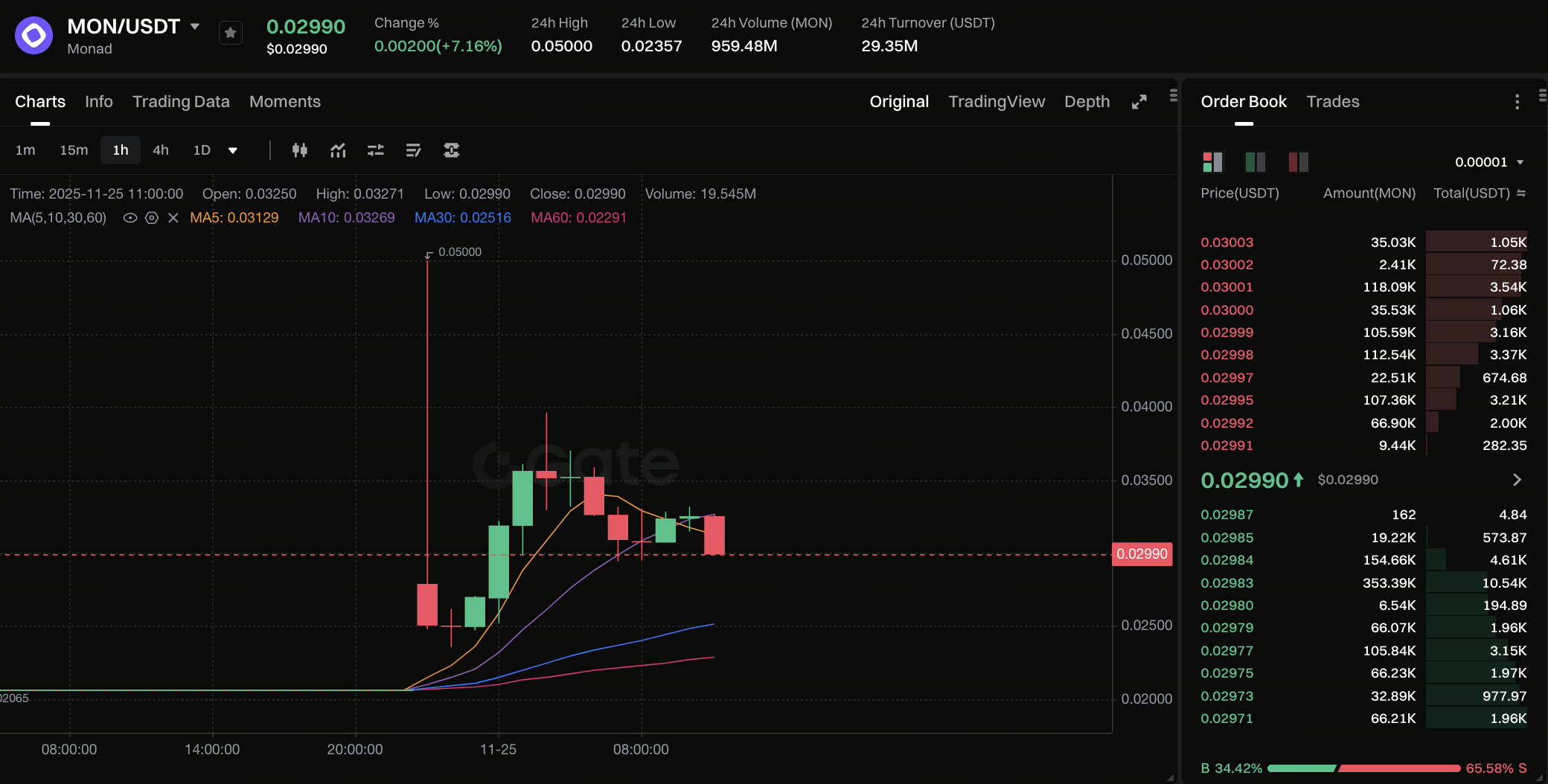
Once trading began, MON’s market performance failed to meet expectations. The token opened at approximately $0.02417, falling short of its public sale price of $0.025. While the difference may seem small, psychological thresholds play a crucial role during token launches—opening below sale price often signals weak early demand.
Within the first 100 minutes of trading, MON recorded only $50 million in volume. For a major Layer-1 project that markets itself as a future Ethereum competitor, this level of early liquidity was underwhelming.
Based on the circulating supply, MON’s initial market capitalization stood at roughly $262 million—respectable, yet far below the valuations typically seen for hyped L1 debuts. As a result, market sentiment quickly shifted from excitement to caution.
Tokenomics Under Scrutiny: Team Allocation Criticized
Beyond the slow start, MON’s tokenomics drew substantial criticism. The distribution plan allocates:
27% to the Monad team
19.7% to investors
4% to the Labs treasury
38.5% to ecosystem development
The 27% team allocation became a focal point for community debate. Critics argued this structure gives the core team disproportionate influence over governance and future price dynamics. Although such allocations are not uncommon, investors increasingly expect leaner team distributions to foster decentralization and reduce sell-off risks.
Additionally, with nearly 60% of the supply locked in non-public allocations, some investors expressed concern about potential long-term dilution.
Co-Founder Responds to Market Concerns
In response to community discussions, co-founder Keone Hon publicly addressed concerns around both the token sale and the distribution structure.
He explained that the slow sale aligned with Monad’s philosophy, emphasizing broad accessibility rather than speculative frenzy. The choice to partner with Coinbase’s algorithmic distribution model—despite its slower pace—was part of this design.
Hon also reiterated that the ecosystem fund’s large allocation would be deployed transparently, with funds directed toward developer grants, growth incentives, partnerships, and long-term network expansion. These commitments, he argued, position Monad for sustainable growth rather than quick hype cycles.
However, while transparency is welcomed, investors remain divided. Some view the team’s measured approach as healthy, while others interpret the slow sale and cautious debut as signs of limited excitement.
Market Outlook: Can MON Recover?
Despite its shaky start, MON’s long-term performance will hinge on several factors:
1.Developer Adoption
Monad aims to compete with high-performance blockchains like Solana, Aptos, and Sui. Its ability to attract developers will determine whether the ecosystem can grow robustly enough to justify its valuation.
2.Liquidity Growth
Early trading was lackluster, but liquidity can improve quickly if major exchanges and market makers deepen support.
3.Token Utility
MON must demonstrate tangible utility beyond speculation—particularly in staking, governance, and network participation.
4.Community Expansion
A broader user base and strong grassroots interest could help MON recover from its underwhelming debut.
5.Macro Market Conditions
Overall crypto market sentiment plays an important role. If broader risk assets strengthen, MON could benefit from renewed inflows.
At present, MON’s launch reflects a cautious market adjusting to higher standards for token distribution, transparency, and genuine demand. The coming weeks will be critical as investors monitor its liquidity, developer activity, and network traction.
Disclaimer:
This is not investment advice. This information is provided for informational purposes only and should not be construed as a recommendation to buy, sell, or hold any asset. Cryptocurrency trading involves a risk of loss. Gate US services may be restricted in certain jurisdictions. For more information, please see our legal disclosures: https://us.gate.com/legal/disclosures
Share
Content


Related Articles

Bitcoin Halving Chart: Key Dates, Trends, and Future Predictions

Bitcoin Halving Chart:Understanding the Changes in Bitcoin Supply and Price Trends

US December Rate Cut Forecast: Will the Federal Reserve Finally Pivot?

Federal Reserve Ends Quantitative Tightening — How the End of QT Could Reshape Global Markets in 2025

Midnight Network Ignites Cardano’s Next Chapter with NIGHT Token Mining and Privacy Innovation