Trustless by Design: Vitalik’s Manifesto for a Truly Decentralized Web3
Beyond Ideals: Trustlessness as a Defense Line
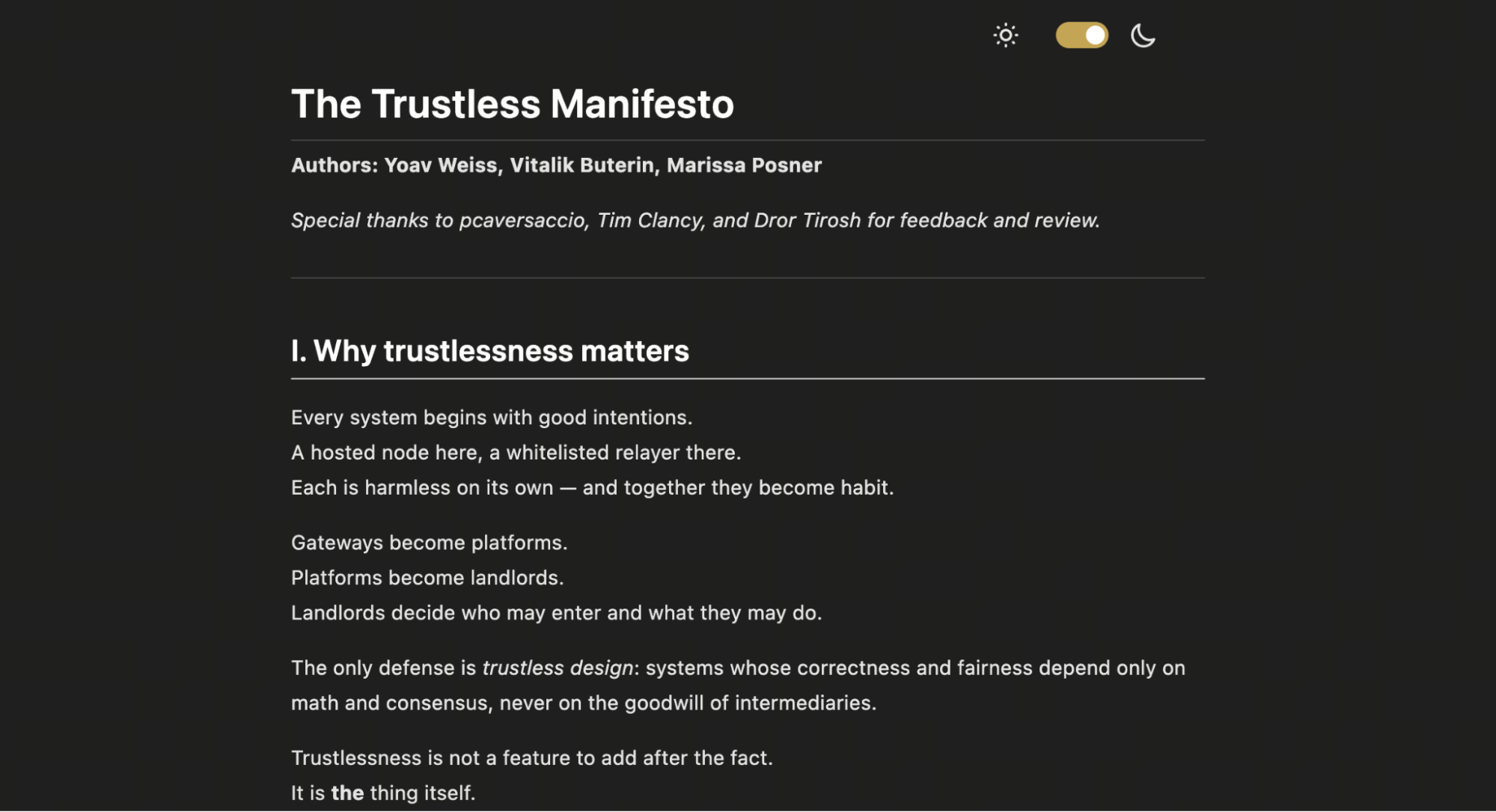
Decentralization was never about efficiency—it was about empowerment. Yet as systems evolve, layers of convenience begin to reintroduce trust into the equation. Custodial nodes, whitelisted relayers, and permissioned bridges may seem harmless, but together they rebuild the very structures decentralization sought to dismantle.
(Image source: trustlessness.eth.limo)
Vitalik argues that trustlessness is not a feature—it’s the foundation. If a blockchain’s neutrality depends on intermediaries, it ceases to be decentralized. Only systems built upon mathematics, consensus, and open protocols can preserve the integrity of Web3.
Ethereum’s Mission: Trust as a Choice, Not a Prerequisite
Ethereum was not designed to be the most efficient financial network, nor a flashy platform for complex apps. Its purpose, as Vitalik reiterates, is to enable collaboration without permission—where individuals interact freely, without reliance on trust.
Ethereum replaces trust with verification and policy with protocol. It stands as a statement that freedom should not depend on benevolent intermediaries but on systems that empower verifiable autonomy for everyone.
The Essence of Trustlessness: Verifiable Freedom
A trustless system doesn’t eliminate trust—it makes it provable. Vitalik highlights several key principles for minimizing trust in decentralized design:
- Self-sovereignty: Users must control their actions without relying on third parties.
- Verifiability: All actions and transactions must be transparent and reproducible.
- Censorship resistance: Valid activity cannot be arbitrarily blocked.
- Redundancy: Any node failure should be replaceable without systemic risk.
- Transparent incentives: Rules and rewards should be open and auditable, never hidden in private APIs.
Whenever these principles are compromised, decentralization quietly turns back toward central control.
The Subtle Return of Convenience-Based Trust
Modern Web3 infrastructure often masks its reliance on trust. Centralized RPC endpoints dominate dApp ecosystems, rollups retain upgrade keys, and many users still depend on exchanges rather than self-custody. Even cross-chain bridges increasingly rely on trusted nodes.
Each trade-off may seem practical—but every concession to convenience chips away at decentralization. Over time, these “temporary solutions” evolve into permanent dependencies, recreating the same trust-based hierarchies that Web3 aimed to escape.
The Developer’s Responsibility: Resist the Comfort Trap
For Vitalik, the developer’s role is not to make systems merely easier, but freer. When usability overrides verifiability, innovation becomes regression.
He proposes three guiding rules for builders:
1.Never depend on secret or privileged information.
2.Avoid irreplaceable intermediaries in protocol design.
3.Ensure all results are open to public verification.
Yes, such rigor demands more work—but it’s this very discipline that preserves the core value of decentralization.
The Path Forward: Growth Through Resistance
Ethereum’s next challenge is not scaling, but staying honest. As Layer 2s, modular systems, and cross-chain protocols expand, the ecosystem must ensure that:
- Users retain full control of their assets.
- Verification remains universally accessible.
- No one can be silently excluded from participation.
Trust minimization isn’t about eliminating errors—it’s about making them visible, correctable, and accountable. A transparent system doesn’t hide flaws; it allows the community to fix them.
Conclusion
Vitalik ends his manifesto with a stark reminder:
“The world doesn’t need more efficient intermediaries — it needs fewer reasons to trust them.”
This single line captures the essence of Web3’s mission. Decentralization isn’t just about distributing data—it’s about redistributing power. Trustlessness isn’t a one-time achievement; it’s an ongoing act of resistance.
When we choose openness over control and verifiability over blind trust, we uphold the spirit of Ethereum itself—a network built on freedom, transparency, and the right to verify everything.
Disclaimer:
This is not investment advice. This information is provided for informational purposes only and should not be construed as a recommendation to buy, sell, or hold any asset. Cryptocurrency trading involves a risk of loss. Gate US services may be restricted in certain jurisdictions. For more information, please see our legal disclosures: https://us.gate.com/legal/disclosures
Share
Content
Beyond Ideals: Trustlessness as a Defense Line
Ethereum’s Mission: Trust as a Choice, Not a Prerequisite
The Essence of Trustlessness: Verifiable Freedom
The Subtle Return of Convenience-Based Trust
The Developer’s Responsibility: Resist the Comfort Trap
The Path Forward: Growth Through Resistance
Conclusion


Related Articles

Bitcoin Halving Chart: Key Dates, Trends, and Future Predictions

Bitcoin Halving Chart:Understanding the Changes in Bitcoin Supply and Price Trends

US December Rate Cut Forecast: Will the Federal Reserve Finally Pivot?

Federal Reserve Ends Quantitative Tightening — How the End of QT Could Reshape Global Markets in 2025

Midnight Network Ignites Cardano’s Next Chapter with NIGHT Token Mining and Privacy Innovation